
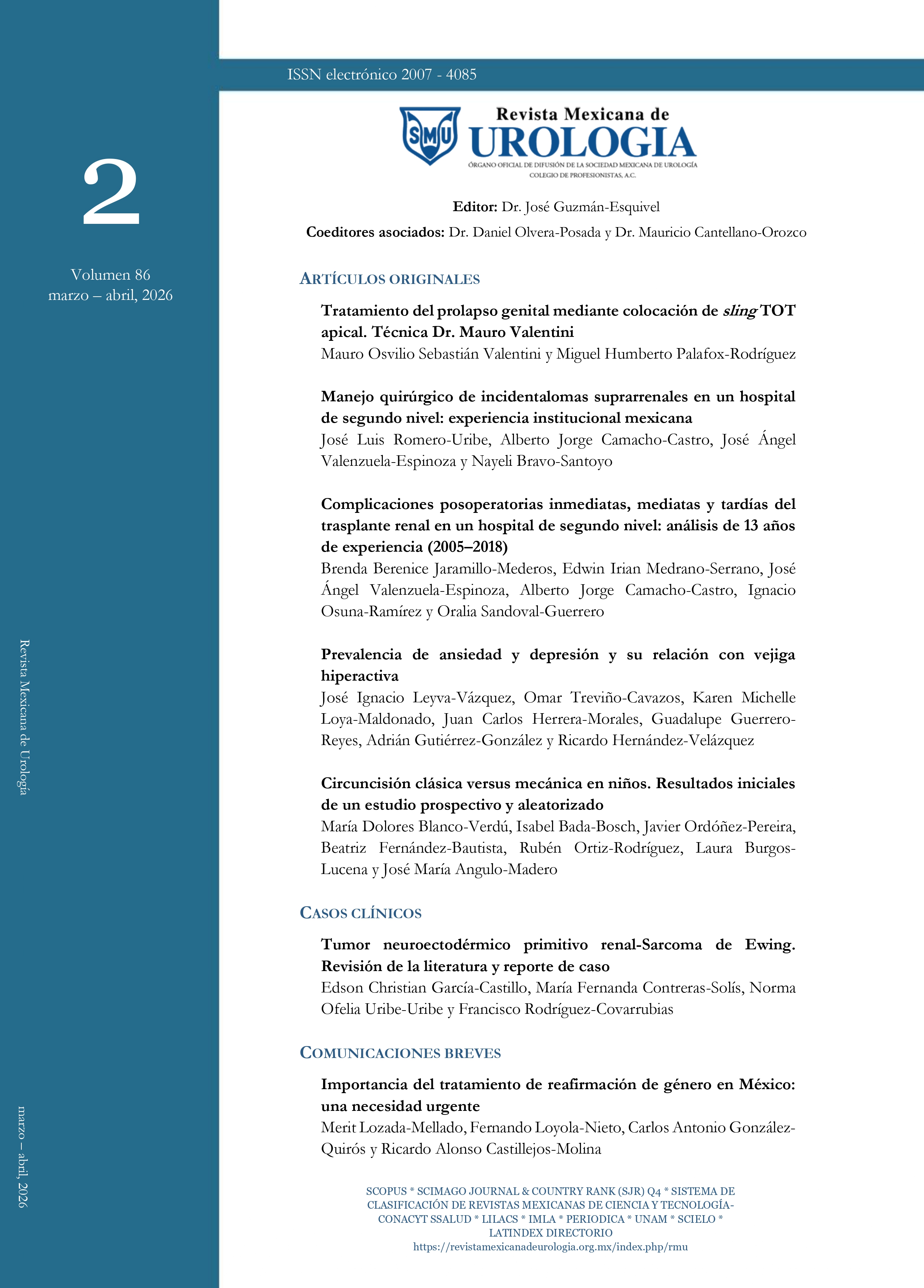
Surgical management of adrenal incidentalomas in a secondary care hospital: mexican institutional experience
DOI:
https://doi.org/10.48193/jx4q0e12Keywords:
adrenal incidentaloma, laparoscopic adrenalectomy, adrenocortical carcinoma, pheochromocytoma, minimally invasive surgical proceduresAbstract
Objective: to analyze the clinical, imaging and surgical characteristics of patients with adrenal incidentalomas undergoing exclusively surgical treatment in a secondary level hospital.
Design: retrospective, observational, and descriptive study including patients diagnosed with adrenal incidentalomas who underwent surgical treatment.
Results: a total of 18 cases were identified, with a mean patient age of 49.8 years (range 29–76). Female predominance was observed (61.1 %), with left-sided lesions in 72.2 % of cases. Laparoscopic adrenalectomy was performed in 66.7 % of patients, mainly for benign tumors (75 %), whereas open surgery was reserved for lesions ≥ 6 cm or with clinical or radiologic suspicion of malignancy. The most frequent histopathological diagnosis was adrenal adenoma (38.9 %), followed by adrenocortical carcinoma (22.2 %) and pheochromocytoma (11.1 %).
Limitations: small sample size and retrospective design; however, the findings are consistent with previously published international series.
Originality: this study represents the first institutional series of adrenal incidentalomas reported from a secondary-level hospital in northwest Mexico, providing local evidence on their clinical and surgical management.
Conclusion: although adrenal incidentalomas are relatively uncommon findings, accurate preoperative functional and imaging assessment combined with an appropriate surgical approach favoring minimally invasive techniques when feasible significantly improves clinical and surgical outcomes.
References
Fassnacht M, Tsagarakis S, Terzolo M, Tabarin A, Sahdev A, Newell-Price J, et al. European Society of Endocrinology clinical practice guidelines on the management of adrenal incidentalomas, in collaboration with the European Network for the Study of Adrenal Tumors. European Journal of Endocrinology. 2023;189(1): G1–G42. https://doi.org/10.1093/ejendo/lvad066.
Zeiger MA, Thompson GB, Duh QY, Hamrahian AH, Angelos P, Elaraj D, et al. American Association of Clinical Endocrinologists and American Association of Endocrine Surgeons Medical Guidelines for the Management of Adrenal Incidentalomas: executive summary of recommendations. Endocrine Practice: Official Journal of the American College of Endocrinology and the American Association of Clinical Endocrinologists. 2009;15(5): 450–453. https://doi.org/10.4158/EP.15.5.450.
Cawood TJ, Hunt PJ, O’Shea D, Cole D, Soule S. Recommended evaluation of adrenal incidentalomas is costly, has high false-positive rates and confers a risk of fatal cancer that is similar to the risk of the adrenal lesion becoming malignant; time for a rethink? European Journal of Endocrinology. 2009;161(4): 513–527. https://doi.org/10.1530/EJE-09-0234.
Young WF. Clinical practice. The incidentally discovered adrenal mass. The New England Journal of Medicine. 2007;356(6): 601–610. https://doi.org/10.1056/NEJMcp065470.
Bovio S, Cataldi A, Reimondo G, Sperone P, Novello S, Berruti A, et al. Prevalence of adrenal incidentaloma in a contemporary computerized tomography series. Journal of Endocrinological Investigation. 2006;29(4): 298–302. https://doi.org/10.1007/BF03344099.
Kim BY, Chun AR, Kim KJ, Jung CH, Kang SK, Mok JO, et al. Clinical Characteristics and Metabolic Features of Patients with Adrenal Incidentalomas with or without Subclinical Cushing’s Syndrome. Endocrinology and Metabolism. 2014;29(4): 457–463. https://doi.org/10.3803/EnM.2014.29.4.457.
Mishra I, Vivek MV, Baliarsinha AK. FRI174 Spectrum Of Presentation Of Adrenal Incidentalomas : Is The Distribution Changing? Experience From A Tertiary Care Centre Of Eastern India. Journal of the Endocrine Society. 2023;7(Suppl 1): bvad114.169. https://doi.org/10.1210/jendso/bvad114.169.
Cho YY, Suh S, Joung JY, Jeong H, Je D, Yoo H, et al. Clinical characteristics and follow-up of Korean patients with adrenal incidentalomas. The Korean Journal of Internal Medicine. 2013;28(5): 557–564. https://doi.org/10.3904/kjim.2013.28.5.557.
Mantero F, Terzolo M, Arnaldi G, Osella G, Masini AM, Alı̀ A, et al. A Survey on Adrenal Incidentaloma in Italy1. The Journal of Clinical Endocrinology & Metabolism. 2000;85(2): 637–644. https://doi.org/10.1210/jcem.85.2.6372.
Mansmann G, Lau J, Balk E, Rothberg M, Miyachi Y, Bornstein SR. The clinically inapparent adrenal mass: update in diagnosis and management. Endocrine Reviews. 2004;25(2): 309–340. https://doi.org/10.1210/er.2002-0031.
Fassnacht M, Arlt W, Bancos I, Dralle H, Newell-Price J, Sahdev A, et al. Management of adrenal incidentalomas: European Society of Endocrinology Clinical Practice Guideline in collaboration with the European Network for the Study of Adrenal Tumors. European Journal of Endocrinology. 2016;175(2): G1–G34. https://doi.org/10.1530/EJE-16-0467.
Boland GWL, Blake MA, Hahn PF, Mayo-Smith WW. Incidental adrenal lesions: principles, techniques, and algorithms for imaging characterization. Radiology. 2008;249(3): 756–775. https://doi.org/10.1148/radiol.2493070976.
Pineda-Murillo J, Vergara-Vizuet J, Hernández-León O, Torres-Aguilar J, Viveros-Contreras C, Marin-Guizar DM, et al. Tratamiento laparoscópico transperitoneal de mielolipoma suprarrenal. Revista mexicana de urología. 2017;77(3): 213–218.
Morelli V, Palmieri S. Adrenal incidentaloma: differential diagnosis and management strategies. Edizioni Minerva Medica. 2019;44(1): 4–18. https://doi.org/10.23736/S0391-1977.18.02868-7
Yoneda K, Shiba E, Watanabe T, Akazawa K, Shimazu K, Takamura Y, et al. Laparoscopic adrenalectomy: lateral transabdominal approach vs posterior retroperitoneal approach. Biomedicine & Pharmacotherapy. 2000;54: 215s–219s. https://doi.org/10.1016/S0753-3322(00)80048-7.
Porpiglia F, Fiori C, Bovio S, Destefanis P, Alì A, Terrone C, et al. Bilateral adrenalectomy for Cushing’s syndrome: a comparison between laparoscopy and open surgery. Journal of Endocrinological Investigation. 2004;27(7): 654–658. https://doi.org/10.1007/BF03347498.
Gac E P, Cabané T P, Jans B J, Marambio G A, Díaz B M, Araya Q V, et al. Manejo quirúrgico del incidentaloma suprarrenal. Revista chilena de cirugía. 2012;64(1): 25–31. https://doi.org/10.4067/S0718-40262012000100005.
Bansal VK, Asuri K, Singh D, Agarwal K, Dixit R, Prakash O, et al. Outcomes following laparoscopic adrenalectomy: Experience of more than two decades at a tertiary care centre. Journal of Minimal Access Surgery. 2025;21(1): 46. https://doi.org/10.4103/jmas.jmas_8_24.
Lee JM, Kim MK, Ko SH, Koh JM, Kim BY, Kim SW, et al. Clinical Guidelines for the Management of Adrenal Incidentaloma. Endocrinology and Metabolism. 2017;32(2): 200–218. https://doi.org/10.3803/EnM.2017.32.2.200.
Koren C, Ferraris F, Lapenna L, Cardinali C, Labrador J, Villaronga A, et al. Manejo quirúrgico de los tumores suprarrenales. Nuestra experiencia. Revista Argentina de Urología. 2012;77(2): 136–141.
Ramírez-Beltrán AA, Rosas-Nava JE, Franco-Morales A, Medrano-Urtecho HM, González-Cuenca E, Corona-Montes VE, et al. Adrenal cyst: our experience in its laparoscopic management. Cirugia Y Cirujanos. 2021;89(2): 252–257. https://doi.org/10.24875/CIRU.20000265.
Downloads
Published
Issue
Section
License
Copyright (c) 2026 Revista Mexicana de Urología

This work is licensed under a Creative Commons Attribution-NonCommercial-NoDerivatives 4.0 International License.


