
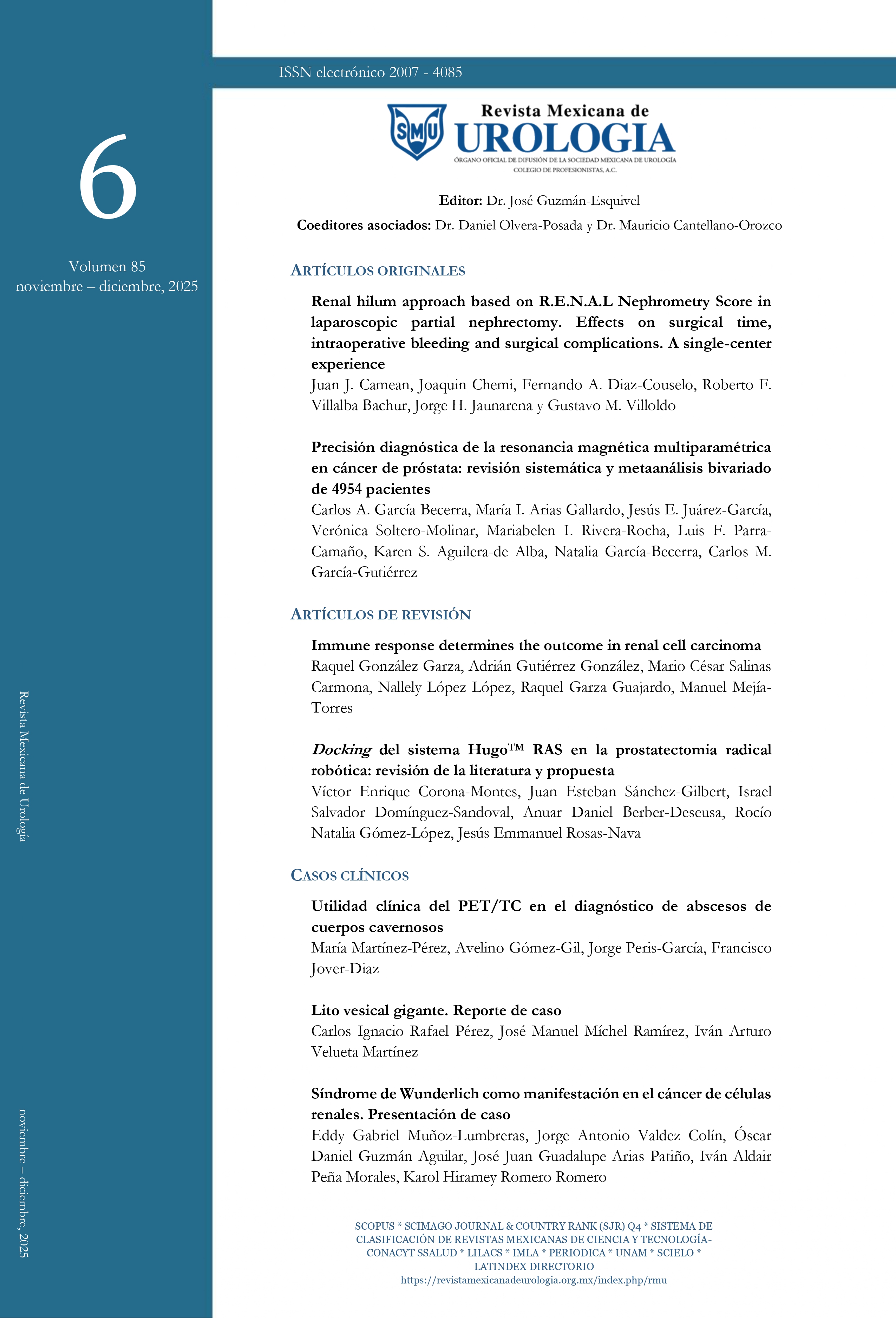
La respuesta inmune determina el desenlace en el carcinoma de células renales
DOI:
https://doi.org/10.48193/xhqswd57Palabras clave:
carcinoma de células renales, inmunoterapia, inhibidores de puntos de control}, microambiente tumoral, inmunopatologíaResumen
El carcinoma de células renales representa una carga sanitaria significativa, asociada a morbilidad y mortalidad. Entre los factores que agravan los desafíos de esta condición se incluyen el diagnóstico tardío, la resistencia intrínseca a la quimioterapia y la heterogeneidad celular de los tumores. Además, el papel de la inmunidad en esta afección fue sugerido por el uso exitoso de la inmunoterapia en el RCC avanzado, lo que requiere comprender los mecanismos inmunopatológicos subyacentes implicados en la progresión de la enfermedad. Asimismo, el estado funcional de las células inmunes infiltradas y los subtipos histológicos tumorales podrían utilizarse como herramientas predictivas para la selección de tratamientos individualizados. Esta revisión resume la información disponible sobre el papel de la inmunidad en los resultados clínicos y la respuesta al tratamiento en pacientes con diagnóstico de RCC.
Referencias
Bray F, Laversanne M, Sung H, Ferlay J, Siegel RL, Soerjomataram I, et al. Global cancer statistics 2022: GLOBOCAN estimates of incidence and mortality worldwide for 36 cancers in 185 countries. CA: a cancer journal for clinicians. 2024;74(3): 229–263. https://doi.org/10.3322/caac.21834.
Azawi NH, Tesfalem H, Mosholt KSS, Høyerup P, Jensen ES, Malchau E, et al. Recurrence rates and survival in a Danish cohort with renal cell carcinoma. Danish Medical Journal. 2016;63(4): A5208.
Mohanty SK, Lobo A, Cheng L. The 2022 revision of the World Health Organization classification of tumors of the urinary system and male genital organs: advances and challenges. Human Pathology. 2023;136: 123–143. https://doi.org/10.1016/j.humpath.2022.08.006.
World Health Organization. WHO Classification of Tumours Online. 2025. https://tumourclassification.iarc.who.int/welcome/
Muglia VF, Prando A. Renal cell carcinoma: histological classification and correlation with imaging findings. Radiologia Brasileira. 2015;48(3): 166–174. https://doi.org/10.1590/0100-3984.2013.1927.
Karthika C, Sureshkumar R, Zehravi M, Akter R, Ali F, Ramproshad S, et al. Multidrug Resistance of Cancer Cells and the Vital Role of P-Glycoprotein. Life (Basel, Switzerland). 2022;12(6): 897. https://doi.org/10.3390/life12060897.
Koury J, Lucero M, Cato C, Chang L, Geiger J, Henry D, et al. Immunotherapies: Exploiting the Immune System for Cancer Treatment. Journal of Immunology Research. 2018;2018: 9585614. https://doi.org/10.1155/2018/9585614.
Mukherjee AG, Wanjari UR, Namachivayam A, Murali R, Prabakaran DS, Ganesan R, et al. Role of Immune Cells and Receptors in Cancer Treatment: An Immunotherapeutic Approach. Vaccines. 2022;10(9): 1493. https://doi.org/10.3390/vaccines10091493.
Chen W, Pan X, Cui X. RCC Immune Microenvironment Subsequent to Targeted Therapy: A Friend or a Foe? Frontiers in Oncology. 2020;10: 573690. https://doi.org/10.3389/fonc.2020.573690.
Fujita K, Kimura G, Tsuzuki T, Kato T, Banno E, Kazama A, et al. The Association of Tumor Immune Microenvironment of the Primary Lesion with Time to Metastasis in Patients with Renal Cell Carcinoma: A Retrospective Analysis. Cancers. 2022;14(21): 5258. https://doi.org/10.3390/cancers14215258.
Sarkar M, Nguyen T, Gundre E, Ogunlusi O, El-Sobky M, Giri B, et al. Cancer-associated fibroblasts: The chief architect in the tumor microenvironment. Frontiers in Cell and Developmental Biology. 2023;11: 1089068. https://doi.org/10.3389/fcell.2023.1089068.
Mirlekar B. Tumor promoting roles of IL-10, TGF-β, IL-4, and IL-35: Its implications in cancer immunotherapy. SAGE open medicine. 2022;10: 20503121211069012. https://doi.org/10.1177/20503121211069012.
Zhang Y, Zhang S, Sun H, Xu L. The pathogenesis and therapeutic implications of metabolic reprogramming in renal cell carcinoma. Cell Death Discovery. 2025;11(1): 186. https://doi.org/10.1038/s41420-025-02479-9.
SALINAS-CARMONA MC, DE LA GARZA J. TNMI may improve current cancer staging. Jornal of Cancerology. 2019;6: 28–30.
Rosales-Velázquez CE, Gallegos-Sánchez G, Montaño-Roca BE, Ruvalcaba-Oceguera GE, Rosales-Velázquez CE, Gallegos-Sánchez G, et al. Abordaje laparoscópico vs abierto para el tratamiento quirúrgico de los tumores renales: Experiencia en el Centro Médico ISSEMyM Toluca, México. Revista mexicana de urología. 2020;80(1). https://doi.org/10.48193/rmu.v80i1.586.
Roos FC, Steffens S, Junker K, Janssen M, Becker F, Wegener G, et al. Survival advantage of partial over radical nephrectomy in patients presenting with localized renal cell carcinoma. BMC Cancer. 2014;14: 372. https://doi.org/10.1186/1471-2407-14-372.
Lalani AKA, Heng DYC, Basappa NS, Wood L, Iqbal N, McLeod D, et al. Evolving landscape of first-line combination therapy in advanced renal cancer: a systematic review. Therapeutic Advances in Medical Oncology. 2022;14: 17588359221108685. https://doi.org/10.1177/17588359221108685.
Pevzner AM, Tsyganov MM, Ibragimova MK, Litvyakov NV. Abscopal effect in the radio and immunotherapy. Radiation Oncology Journal. 2021;39(4): 247–253. https://doi.org/10.3857/roj.2021.00115.
Thomson RJ, Moshirfar M, Ronquillo Y. Tyrosine Kinase Inhibitors. In: StatPearls. Treasure Island (FL): StatPearls Publishing; 2025. http://www.ncbi.nlm.nih.gov/books/NBK563322/ [Accessed 12th December 2025].
Vento JA, Rini BI. Treatment of Refractory Metastatic Renal Cell Carcinoma. Cancers. 2022;14(20): 5005. https://doi.org/10.3390/cancers14205005.
Chang E, Weinstock C, Zhang L, Fiero MH, Zhao M, Zahalka E, et al. FDA Approval Summary: Tivozanib for Relapsed or Refractory Renal Cell Carcinoma. Clinical Cancer Research: An Official Journal of the American Association for Cancer Research. 2022;28(3): 441–445. https://doi.org/10.1158/1078-0432.CCR-21-2334.
Jaafar J, Fernandez E, Alwan H, Philippe J. Programmed cell death-1 and programmed cell death ligand-1 antibodies-induced dysthyroidism. Endocrine Connections. 2018;7(5): R196–R211. https://doi.org/10.1530/EC-18-0079.
Wu M, Huang Q, Xie Y, Wu X, Ma H, Zhang Y, et al. Improvement of the anticancer efficacy of PD-1/PD-L1 blockade via combination therapy and PD-L1 regulation. Journal of Hematology & Oncology. 2022;15(1): 24. https://doi.org/10.1186/s13045-022-01242-2.
Motzer RJ, Escudier B, McDermott DF, George S, Hammers HJ, Srinivas S, et al. Nivolumab versus Everolimus in Advanced Renal-Cell Carcinoma. New England Journal of Medicine. 2015;373(19): 1803–1813. https://doi.org/10.1056/NEJMoa1510665.
Tannir NM, Albigès L, McDermott DF, Burotto M, Choueiri TK, Hammers HJ, et al. Nivolumab plus ipilimumab versus sunitinib for first-line treatment of advanced renal cell carcinoma: extended 8-year follow-up results of efficacy and safety from the phase III CheckMate 214 trial. Annals of Oncology: Official Journal of the European Society for Medical Oncology. 2024;35(11): 1026–1038. https://doi.org/10.1016/j.annonc.2024.07.727.
Takamatsu K, Tanaka N, Hakozaki K, Takahashi R, Teranishi Y, Murakami T, et al. Profiling the inhibitory receptors LAG-3, TIM-3, and TIGIT in renal cell carcinoma reveals malignancy. Nature Communications. 2021;12(1): 5547. https://doi.org/10.1038/s41467-021-25865-0.
Rini BI, Plimack ER, Stus V, Gafanov R, Hawkins R, Nosov D, et al. Pembrolizumab plus Axitinib versus Sunitinib for Advanced Renal-Cell Carcinoma. New England Journal of Medicine. 2019;380(12): 1116–1127. https://doi.org/10.1056/NEJMoa1816714.
Motzer RJ, Penkov K, Haanen J, Rini B, Albiges L, Campbell MT, et al. Avelumab plus Axitinib versus Sunitinib for Advanced Renal-Cell Carcinoma. New England Journal of Medicine. 2019;380(12): 1103–1115. https://doi.org/10.1056/NEJMoa1816047.
Rini BI, Powles T, Atkins MB, Escudier B, McDermott DF, Suarez C, et al. Atezolizumab plus bevacizumab versus sunitinib in patients with previously untreated metastatic renal cell carcinoma (IMmotion151): a multicentre, open-label, phase 3, randomised controlled trial. The Lancet. 2019;393(10189): 2404–2415. https://doi.org/10.1016/S0140-6736(19)30723-8.
Choueiri TK, Powles T, Burotto M, Escudier B, Bourlon MT, Zurawski B, et al. Nivolumab plus Cabozantinib versus Sunitinib for Advanced Renal-Cell Carcinoma. New England Journal of Medicine. 2021;384(9): 829–841. https://doi.org/10.1056/NEJMoa2026982.
Motzer R, Alekseev B, Rha SY, Porta C, Eto M, Powles T, et al. Lenvatinib plus Pembrolizumab or Everolimus for Advanced Renal Cell Carcinoma. New England Journal of Medicine. 2021;384(14): 1289–1300. https://doi.org/10.1056/NEJMoa2035716.
Powles T, Plimack ER, Soulières D, Waddell T, Stus V, Gafanov R, et al. Pembrolizumab plus axitinib versus sunitinib monotherapy as first-line treatment of advanced renal cell carcinoma (KEYNOTE-426): extended follow-up from a randomised, open-label, phase 3 trial. The Lancet. Oncology. 2020;21(12): 1563–1573. https://doi.org/10.1016/S1470-2045(20)30436-8.
Pal SK, Albiges L, Tomczak P, Suárez C, Voss MH, de Velasco G, et al. Atezolizumab plus cabozantinib versus cabozantinib monotherapy for patients with renal cell carcinoma after progression with previous immune checkpoint inhibitor treatment (CONTACT-03): a multicentre, randomised, open-label, phase 3 trial. Lancet (London, England). 2023;402(10397): 185–195. https://doi.org/10.1016/S0140-6736(23)00922-4.
Tannir NM, Formiga MN, Penkov K, Kislov N, Vasiliev A, Gunnar Skare N, et al. Bempegaldesleukin Plus Nivolumab Versus Sunitinib or Cabozantinib in Previously Untreated Advanced Clear Cell Renal Cell Carcinoma: A Phase III Randomized Study (PIVOT-09). Journal of Clinical Oncology: Official Journal of the American Society of Clinical Oncology. 2024;42(23): 2800–2811. https://doi.org/10.1200/JCO.23.02082.
Buechner J, Kersten MJ, Fuchs M, Salmon F, Jäger U. Chimeric Antigen Receptor-T Cell Therapy: Practical Considerations for Implementation in Europe. HemaSphere. 2018;2(1): e18. https://doi.org/10.1097/HS9.0000000000000018.
Maude SL, Barrett D, Teachey DT, Grupp SA. Managing cytokine release syndrome associated with novel T cell-engaging therapies. Cancer Journal (Sudbury, Mass.). 2014;20(2): 119–122. https://doi.org/10.1097/PPO.0000000000000035.
Campos NSP de, Souza BS, Silva GCP da, Porto VA, Chalbatani GM, Lagreca G, et al. Carbonic Anhydrase IX: A Renewed Target for Cancer Immunotherapy. Cancers. 2022;14(6): 1392. https://doi.org/10.3390/cancers14061392.
Qu C, Zhang H, Cao H, Tang L, Mo H, Liu F, et al. Tumor buster - where will the CAR-T cell therapy ‘missile’ go? Molecular Cancer. 2022;21(1): 201. https://doi.org/10.1186/s12943-022-01669-8.
Li X, Zhang Y, Ye Y, Xiao W, Liu L, Zhang X. NK cells in renal cell carcinoma and its implications for CAR-NK therapy. Frontiers in Cell and Developmental Biology. 2025;13. https://doi.org/10.3389/fcell.2025.1532491.
Wang QT, Nie Y, Sun SN, Lin T, Han RJ, Jiang J, et al. Tumor-associated antigen-based personalized dendritic cell vaccine in solid tumor patients. Cancer immunology, immunotherapy: CII. 2020;69(7): 1375–1387. https://doi.org/10.1007/s00262-020-02496-w.
Miricescu D, Balan DG, Tulin A, Stiru O, Vacaroiu IA, Mihai DA, et al. PI3K/AKT/mTOR signalling pathway involvement in renal cell carcinoma pathogenesis (Review). Experimental and Therapeutic Medicine. 2021;21(5): 540. https://doi.org/10.3892/etm.2021.9972.
Ye X, Ruan JW, Huang H, Huang WP, Zhang Y, Zhang F. PI3K-Akt-mTOR inhibition by GNE-477 inhibits renal cell carcinoma cell growth in vitro and in vivo. Aging. 2020;12(10): 9489–9499. https://doi.org/10.18632/aging.103221.
Shah AY, Kotecha RR, Lemke EA, Chandramohan A, Chaim JL, Msaouel P, et al. Outcomes of patients with metastatic clear-cell renal cell carcinoma treated with second-line VEGFR-TKI after first-line immune checkpoint inhibitors. European Journal of Cancer (Oxford, England: 1990). 2019;114: 67–75. https://doi.org/10.1016/j.ejca.2019.04.003.
Choueiri TK, Bauer TM, Papadopoulos KP, Plimack ER, Merchan JR, McDermott DF, et al. Inhibition of hypoxia-inducible factor-2α in renal cell carcinoma with belzutifan: a phase 1 trial and biomarker analysis. Nature Medicine. 2021;27(5): 802–805. https://doi.org/10.1038/s41591-021-01324-7.
Lorentzen CL, Haanen JB, Met Ö, Svane IM. Clinical advances and ongoing trials on mRNA vaccines for cancer treatment. The Lancet. Oncology. 2022;23(10): e450–e458. https://doi.org/10.1016/S1470-2045(22)00372-2.
Descargas
Publicado
Número
Sección
Licencia
Derechos de autor 2026 Revista Mexicana de Urología

Esta obra está bajo una licencia internacional Creative Commons Atribución-NoComercial-SinDerivadas 4.0.


