
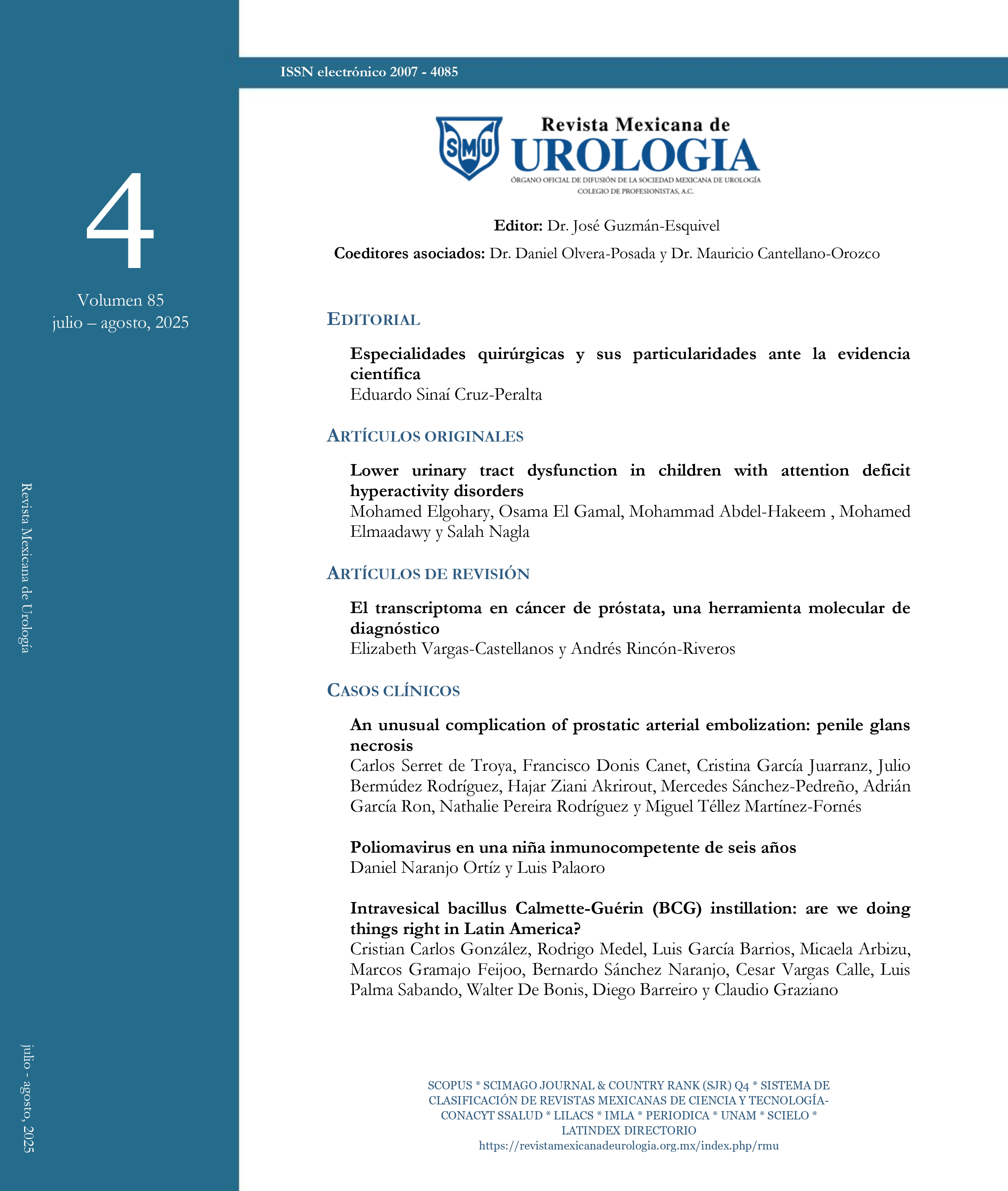
Lower urinary tract dysfunction in children with attention deficit hyperactivity disorders
DOI:
https://doi.org/10.48193/4cdj6996Keywords:
Lower Urinary Tract Dysfunction, Attention Deficit Hyperactivity Disorders, Nocturnal EnuresisAbstract
Goal: the aim of this work was to identify the various types of lower urinary tract dysfunctions (LUTD among children with Attention Deficit Hyperactivity Disorders (ADHD) and their responses to treatments.
Methods: this prospective work had been conducted on participants aged 6 -18 years old, who fulfilled criteria for ADHD with any type of LUTD and only naive patients who had no previous urological treatment. All patients were subjected to the standard psychiatric treatment in form of Atomoxetine and/or methylphenidate. The patients were re-evaluated at 1,3,6 months to assess improvement of daytime symptoms and nocturnal enuresis (NE).
Results: in our 60 patients, there was no significant different between recurrence rate of NE and type of ADHD and NE. There was no significant different between type of ADHD according to response of enuresis treatment. Regarding response of treatment of daytime symptoms, 14 (77.7 %) patients showed full response, while 4 (22.2 %) patients did not show response. In patients with NE, 28 (66.7 %) patients showed full response, 8 (19.0 %) patients showed intermediate response, and 6 (14.3 %) patients did not show response. While in patients with non- monosymptomatic NE, 14 (77.8 %) Patients with showed full response, while 4(22.2 %) did not show response.
Conclusions: a combination therapy of desmopressin and imipramine is efficient treatment of monosymptomatic NE in ADHD children, while anticholinergic drugs plus desmopressin are effective in non-monosymptomtic NE.
Limitations: number of cases is small and further multicenter studies are needed to confirm our conclusion.
Originality: this manuscript describes an original work.
References
Ito H, Sakamaki K, Young GJ, Blair PS, Hashim H, Lane JA, et al. Predicting Prostate Surgery Outcomes from Standard Clinical Assessments of Lower Urinary Tract Symptoms To Derive Prognostic Symptom and Flowmetry Criteria. European Urology Focus. 2024;10(1): 197–204. https://doi.org/10.1016/j.euf.2023.06.013.
Jefferies M, Cox A, Bennett A, Kynaston H. Management of lower urinary tract symptoms in men. British Journal of Hospital Medicine (London, England: 2005). 2013;74(9): 518–522. https://doi.org/10.12968/hmed.2013.74.9.518.
Chapple CR, Wein AJ, Abrams P, Dmochowski RR, Giuliano F, Kaplan SA, et al. Lower urinary tract symptoms revisited: a broader clinical perspective. European Urology. 2008;54(3): 563–569. https://doi.org/10.1016/j.eururo.2008.03.109.
Abrams P, Cardozo L, Fall M, Griffiths D, Rosier P, Ulmsten U, et al. The standardisation of terminology in lower urinary tract function: report from the standardisation sub-committee of the International Continence Society. Urology. 2003;61(1): 37–49. https://doi.org/10.1016/s0090-4295(02)02243-4.
Reynard JM, Yang Q, Donovan JL, Peters TJ, Schafer W, de la Rosette JJ, et al. The ICS-’BPH’ Study: uroflowmetry, lower urinary tract symptoms and bladder outlet obstruction. British Journal of Urology. 1998;82(5): 619–623. https://doi.org/10.1046/j.1464-410x.1998.00813.x.
Scarpa RM. Lower urinary tract symptoms: what are the implications for the patients? European Urology. 2001;40 Suppl 4: 12–20. https://doi.org/10.1159/000049890.
Appell RA, Sand PK. Nocturia: etiology, diagnosis, and treatment. Neurourology and Urodynamics. 2008;27(1): 34–39. https://doi.org/10.1002/nau.20484.
Fowler CJ, Griffiths D, de Groat WC. The neural control of micturition. Nature Reviews. Neuroscience. 2008;9(6): 453–466. https://doi.org/10.1038/nrn2401.
Gnanavel S, Sharma P, Kaushal P, Hussain S. Attention deficit hyperactivity disorder and comorbidity: A review of literature. World Journal of Clinical Cases. 2019;7(17): 2420–2426. https://doi.org/10.12998/wjcc.v7.i17.2420.
Khazaie H, Eghbali F, Amirian H, Moradi MR, Ghadami MR. Risk Factors of Nocturnal Enuresis in Children with Attention Deficit Hyperactivity Disorder. Shanghai Archives of Psychiatry. 2018;30(1): 20–26. https://doi.org/10.11919/j.issn.1002-0829.216088.
Ghanavati PM, Khazaeli D, Amjadzadeh M. A comparison of the efficacy and tolerability of treating primary nocturnal enuresis with Solifenacin Plus Desmopressin, Tolterodine Plus Desmopressin, and Desmopressin alone: a randomized controlled clinical trial. International braz j urol. 2021;47(1): 73–81. https://doi.org/10.1590/s1677-5538.ibju.2019.0448.
Amiri S, Shafiee-Kandjani AR, Naghinezhad R, Farhang S, Abdi S. Comorbid Psychiatric Disorders in Children and Adolescents with Nocturnal Enuresis. Urology Journal. 2017;14(1): 2968–2972.
Okur M, Ruzgar H, Erbey F, Kaya A. The evaluation of children with monosymptomatic nocturnal enuresis for attention deficit and hyperactivity disorder. International Journal of Psychiatry in Clinical Practice. 2012;16(3): 229–232. https://doi.org/10.3109/13651501.2011.620129.
Yousefichaijan P, Sharafkhah M, Salehi B, Rafiei M. Attention deficit hyperactivity disorder in children with primary monosymptomatic nocturnal enuresis: A case-control study. Saudi Journal of Kidney Diseases and Transplantation: An Official Publication of the Saudi Center for Organ Transplantation, Saudi Arabia. 2016;27(1): 73–80. https://doi.org/10.4103/1319-2442.174077.
Mahjani B, Koskela LR, Mahjani CG, Janecka M, Batuure A, Hultman CM, et al. Systematic review and meta-analysis: relationships between attention-deficit/hyperactivity disorder and urinary symptoms in children. European Child & Adolescent Psychiatry. 2022;31(4): 663–670. https://doi.org/10.1007/s00787-021-01736-3.
Duel BP, Steinberg-Epstein R, Hill M, Lerner M. A survey of voiding dysfunction in children with attention deficit-hyperactivity disorder. The Journal of Urology. 2003;170(4 Pt 2): 1521–1523; discussion 1523-1524. https://doi.org/10.1097/01.ju.0000091219.46560.7b.
Woo SH, Park KH. Enuresis alarm treatment as a second line to pharmacotherapy in children with monosymptomatic nocturnal enuresis. The Journal of Urology. 2004;171(6 Pt 2): 2615–2617. https://doi.org/10.1097/01.ju.0000113036.13536.29.
McKeown C, Hisle-Gorman E, Eide M, Gorman GH, Nylund CM. Association of constipation and fecal incontinence with attention-deficit/hyperactivity disorder. Pediatrics. 2013;132(5): e1210-1215. https://doi.org/10.1542/peds.2013-1580.
Williamson LB, Gower M, Ulzen T. Clinical Case Rounds in Child and Adolescent Psychiatry. Journal of the Canadian Academy of Child and Adolescent Psychiatry. 2011;20(1): 53–55.
Bahali K, Ipek H, Uneri OS. Methylphenidate and atomoxetine for treatment of nocturnal enuresis in a child with attention-deficit hyperactivity disorder. European Child & Adolescent Psychiatry. 2013;22(10): 649–650. https://doi.org/10.1007/s00787-013-0414-x.
Sumner CR, Schuh KJ, Sutton VK, Lipetz R, Kelsey DK. Placebo-controlled study of the effects of atomoxetine on bladder control in children with nocturnal enuresis. Journal of Child and Adolescent Psychopharmacology. 2006;16(6): 699–711. https://doi.org/10.1089/cap.2006.16.699.
von Gontard A, Vrijens D, Selai C, Mosiello G, Panicker J, van Koeveringe G, et al. Are psychological comorbidities important in the aetiology of lower urinary tract dysfunction-ICI-RS 2018? Neurourology and Urodynamics. 2019;38 Suppl 5: S8–S17. https://doi.org/10.1002/nau.24016.
Eliezer DD, Samnakay N, Starkey MR, Deshpande AV. Effectiveness of standard urotherapy (basic bladder advice) and combination therapies in managing bladder dysfunction in children with treated behavioral disorders: Results of a prospective cohort (DABBED) study. Lower Urinary Tract Symptoms. 2021;13(4): 490–497. https://doi.org/10.1111/luts.12400.
Shain S, Gitlin J, Pantazis A, Fine R, Horowitz M, Friedman S, et al. Management of the refractory nocturnal enuresis patient to desmopressin in a pediatric population: Desmopressin + oxybutynin vs. desmopressin + imipramine. Journal of Pediatric Urology. 2024;20(4): 603.e1-603.e8. https://doi.org/10.1016/j.jpurol.2024.05.024.
Fujinaga S, Nishizaki N, Ohtomo Y. Initial combination therapy with desmopressin, solifenacin, and alarm for monosymptomatic nocturnal enuresis. Pediatrics International: Official Journal of the Japan Pediatric Society. 2017;59(3): 383–384. https://doi.org/10.1111/ped.13212.
Reddy KR, Sripada R. Treatment and management of nocturnal enuresis: a review. International Journal of Pharmaceutical and Clinical Research. 2017;9(5): 363–367.
von Gontard A, Equit M. Comorbidity of ADHD and incontinence in children. European Child & Adolescent Psychiatry. 2015;24(2): 127–140. https://doi.org/10.1007/s00787-014-0577-0.
Fritz G, Rockney R, Bernet W, Arnold V, Beitchman J, Benson RS, et al. Practice parameter for the assessment and treatment of children and adolescents with enuresis. Journal of the American Academy of Child and Adolescent Psychiatry. 2004;43(12): 1540–1550. https://doi.org/10.1097/01.chi.0000142196.41215.cc.
Samir M, Mahmoud MA, Elawady H. Can the combined treatment of solifenacin and imipramine has a role in desmopressin refractory monosymptomatic nocturnal enuresis? A prospective double-blind randomized placebo-controlled study. Urologia. 2021;88(4): 369–373. https://doi.org/10.1177/0391560321993587.
Cai T, Yao Y, Sun W, Lei P. Desmopressin in combination with anticholinergic agents in the treatment of nocturnal enuresis: a systematic review and meta-analysis. Frontiers in Pediatrics. 2023;11: 1242777. https://doi.org/10.3389/fped.2023.1242777.
Ghanavati PM, Khazaeli D, Amjadzadeh M. A comparison of the efficacy and tolerability of treating primary nocturnal enuresis with Solifenacin Plus Desmopressin, Tolterodine Plus Desmopressin, and Desmopressin alone: a randomized controlled clinical trial. International braz j urol. 2021;47(1): 73–81. https://doi.org/10.1590/s1677-5538.ibju.2019.0448.
Seyfhashemi M, Ghorbani R, Zolfaghari A. Desmopressin, Imipramine, and Oxybutynin in the Treatment of Primary Nocturnal Enuresis: A Randomized Clinical Trial. Iranian Red Crescent Medical Journal. 2015;17(7): e16174. https://doi.org/10.5812/ircmj.16174v2.
Gökçe Mİ, Hajıyev P, Süer E, Kibar Y, Sılay MS, Gürocak S, et al. Does structured withdrawal of desmopressin improve relapse rates in patients with monosymptomatic enuresis? The Journal of Urology. 2014;192(2): 530–534. https://doi.org/10.1016/j.juro.2014.01.094.
Downloads
Published
Issue
Section
License
Copyright (c) 2025 Revista Mexicana de Urología

This work is licensed under a Creative Commons Attribution-NonCommercial-NoDerivatives 4.0 International License.


