
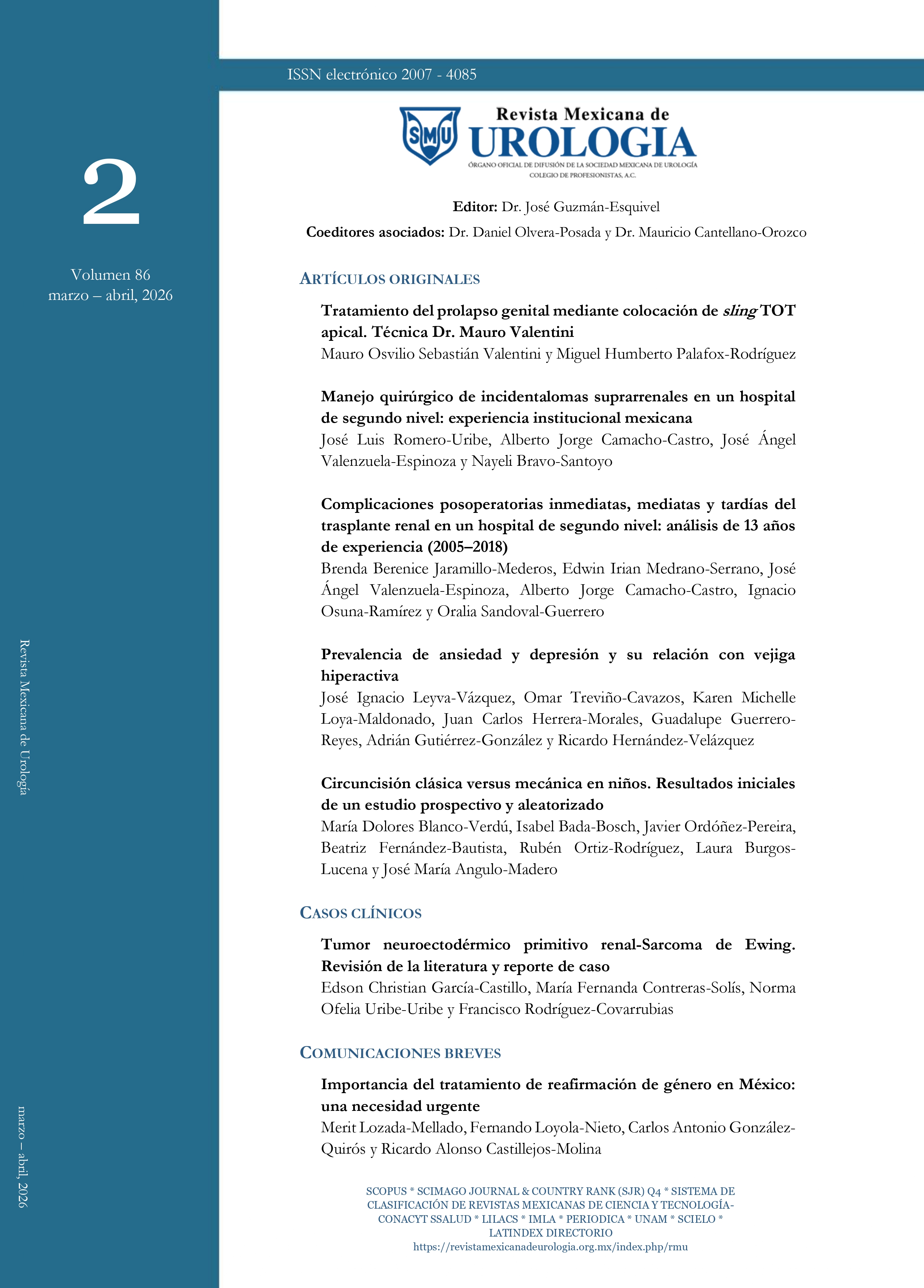
Classic versus mechanical circumcision in boys. Initial results of a prospective randomized study
DOI:
https://doi.org/10.48193/webgf359Keywords:
Circumcision, mechanical, child, pediatrics, deviceAbstract
Objective: to compare the clinical and aesthetic results of mechanical circumcision with stapler versus the classic technique in the pediatric population.
Methodology: prospective, randomized, single-center study. Fifty children between 6 and 16 years old with indication for circumcision were included, randomly assigned to classic (n = 25) or mechanical (n = 25) technique. Operative, postoperative and satisfaction variables were analyzed by Student's t-test and chi-square.
Results: both techniques showed similar results in age, pain, postoperative complications, return to activities and satisfaction of patients, parents and surgeons. Surgical time was significantly shorter with the mechanical technique (10.4 vs. 19.7 min; p < 0.0001), as well as the incidence of asymmetry (0 % vs. 24 %; p = 0.013). No serious complications were recorded.
Limitations of the study: the study has a small sample size and does not perform an economic evaluation.
Originality: this work is among the first studies that prospectively and randomly compare mechanical circumcision versus the classic technique in the pediatric population. In a context of very limited literature, this work emerges as a relevant contribution to evaluate the feasibility and safety of mechanical devices in pediatric circumcision.
Conclusions: mechanical circumcision appears to be a safe and effective alternative to classical circumcision techniques in the pediatric population, significantly reducing surgical time and improving symmetry, with comparable complication and satisfaction rates.
References
Hohlfeld A, Ebrahim S, Shaik MZ, Kredo T. Circumcision devices versus standard surgical techniques in adolescent and adult male circumcisions. The Cochrane Database of Systematic Reviews. 2021;3(3): CD012250. https://doi.org/10.1002/14651858.CD012250.pub2.
Rao JM, Huang H, Chen T, Yang CG, Pan CZ, Deng GC, et al. Modified Circumcision Using the Disposable Circumcision Suture Device in Children: A Randomized Controlled Trial. Urology. 2020;143: 206–211. https://doi.org/10.1016/j.urology.2020.06.018.
Jiang Z, Chen H, Wu M, Li I, Li H, Jiang M, et al. Safety and Efficacy of Circumcision Stapler in the Treatment for Children with Phimosis and Redundant Prepuce. Open Journal of Urology. 2018;8(9): 263–266. https://doi.org/10.4236/oju.2018.89029.
Wang J, Zhou Y, Xia S, Zhu Z, Jia L, Liu Y, et al. Safety and efficacy of a novel disposable circumcision device: A pilot randomized controlled clinical trial at 2 centers. Medical Science Monitor. 2014;20: 454–462. https://doi.org/10.12659/MSM.889722.
Clavien PA, Barkun J, de Oliveira ML, Vauthey JN, Dindo D, Schulick RD, et al. The Clavien-Dindo classification of surgical complications: five-year experience. Annals of Surgery. 2009;250(2): 187–196. https://doi.org/10.1097/SLA.0b013e3181b13ca2.
Krill AJ, Palmer LS, Palmer JS. Complications of circumcision. TheScientificWorldJournal. 2011;11: 2458–2468. https://doi.org/10.1100/2011/373829.
Chou AC, Laih CY, Ku FY. A Retrospective Taiwanese-Population-Based Clinical Study on Determining the Efficacy and Safety of Disposable Circumcision Anastomat. Journal of Clinical Medicine. 2022;11(20): 6206. https://doi.org/10.3390/jcm11206206.
World Health Organization. Male Circumcision for HIV Prevention: WHO Technical Advisory Group on Innovations in Male Circumcision: Evaluation of two adult devices. 2013.
Craig JC, Knight JF, Sureshkumar P, Mantz E, Roy LP. Effect of circumcision on incidence of urinary tract infection in preschool boys. The Journal of Pediatrics. 1996;128(1): 23–27. https://doi.org/10.1016/s0022-3476(96)70423-7
Bailey RC, Moses S, Parker CB, Agot K, Maclean I, Krieger JN, et al. Male circumcision for HIV prevention in young men in Kisumu, Kenya: a randomised controlled trial. Lancet. 2007;369(9562): 643–656. https://doi.org/10.1016/S0140-6736(07)60312-2.
Gray RH, Kigozi G, Serwadda D, Makumbi F, Watya S, Nalugoda F, et al. Male circumcision for HIV prevention in men in Rakai, Uganda: a randomised trial. Lancet. 2007;369(9562): 657–666. https://doi.org/10.1016/S0140-6736(07)60313-4.
Daling JR, Madeleine MM, Johnson LG, Schwartz SM, Shera KA, Wurscher MA, et al. Penile cancer: importance of circumcision, human papillomavirus and smoking in in situ and invasive disease. International Journal of Cancer. 2005;116(4): 606–616. https://doi.org/10.1002/ijc.21009.
Arunachalam P, King PA, Orford J. A prospective comparison of tissue glue versus sutures for circumcision. Pediatric Surgery International. 2003;19(1–2): 18–19. https://doi.org/10.1007/s00383-002-0893-1.
Alanis MC, Lucidi RS. Neonatal circumcision: a review of the world’s oldest and most controversial operation. Obstetrical & Gynecological Survey. 2004;59(5): 379–395. https://doi.org/10.1097/00006254-200405000-00026.
Jin XD, Lu JJ, Liu WH, Zhou J, Yu RK, Yu B, et al. Adult male circumcision with a circular stapler versus conventional circumcision: A prospective randomized clinical trial. Brazilian Journal of Medical and Biological Research = Revista Brasileira De Pesquisas Medicas E Biologica. 2015;48(6): 577–582. https://doi.org/10.1590/1414-431X20154530.
World Health Organization. Framework For Clinical evaluation of Devices for male Circumcision. 2012.
Huo ZC, Liu G, Li XY, Liu F, Fan WJ, Guan RH, et al. Use of a disposable circumcision suture device versus conventional circumcision: a systematic review and meta-analysis. Asian Journal of Andrology. 2017;19(3): 362–367. https://doi.org/10.4103/1008-682X.174855.
Huo Z chao, Liu G, Wang W, He D guang, Yu H, Fan W ju, et al. Clinical effect of circumcision stapler in the treatment of phimosis and redundant prepuce. Zhonghua Nan Ke Xue = National Journal of Andrology. 2015;21(4): 330–333.
Miao H dong, Lu J wei, Lu F nian, Shen F, Yuan X lin, Liu H yong. Clinical effects of the circumcision stapler, foreskin cerclage, and traditional circumcision: A comparative study. Zhonghua Nan Ke Xue = National Journal of Andrology. 2015;21(4): 334–337.
Pozza D, Pozza C, Mosca A, Pozza M. Preputial circumcision performed with a new mechanical stapling tool. The ‘langhe disposable circumcision suture device’. Preliminary experiences. Archivio Italiano Di Urologia, Andrologia: Organo Ufficiale [di] Societa Italiana Di Ecografia Urologica E Nefrologica. 2020;91(4): 261–262. https://doi.org/10.4081/aiua.2019.4.261.
Jiang W, Fu J li, Guo W liang, Yan Z chun, Zheng R qiang, Lu J ru, et al. A Modified Pressure Dressing to Avoid Severe Bleeding After Circumcision With a Disposable Circumcision Suture Device and a Discussion on the Mechanism of Bleeding With the Disposable Circumcision Suture Device. Sexual Medicine. 2021;9(2): 100288. https://doi.org/10.1016/j.esxm.2020.100288.
Callegari M, Muncey W, Kim T, Rhodes S, Woo L, Hannick J. Where to draw the line? Understanding preferences in mucosal collar length after circumcision: A crowdsourced survey from the U.S. general population. Canadian Urological Association Journal = Journal De l’Association Des Urologues Du Canada. 2022;16(9): E473–E478. https://doi.org/10.5489/cuaj.7691.
Downloads
Published
Issue
Section
License
Copyright (c) 2026 Revista Mexicana de Urología

This work is licensed under a Creative Commons Attribution-NonCommercial-NoDerivatives 4.0 International License.


