
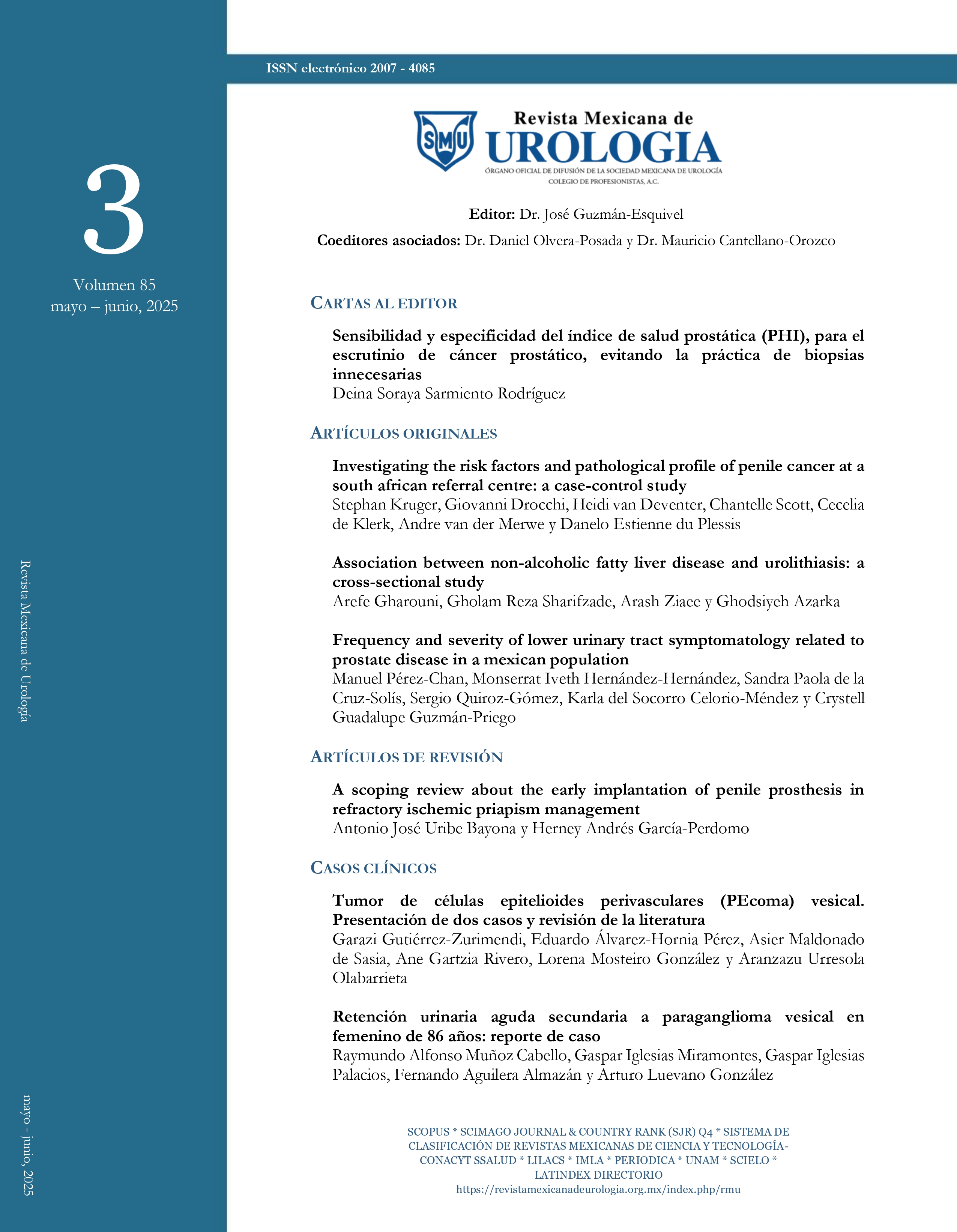
Frequency and severity of lower urinary tract symptomatology related to prostate disease in a mexican population
DOI:
https://doi.org/10.48193/gdcjd906Keywords:
Lower Urinary Tract Symptoms, Prevalence, Prostatic Hyperplasia, Prostatic NeoplasmsAbstract
Objective: To evaluate the frequency and severity of prostate symptoms in men aged 40-70 years in Tabasco, Mexico, where the lack of local data limits prevention strategies and early detection of pathologies such as prostate cancer and benign prostatic hyperplasia (BPH).
Methods: Descriptive, cross-sectional study (February-August 2024) of 383 randomly selected men. The International Prostate Symptom Scale (IPSS) and a socio-demographic questionnaire were used. Data were analyzed with SPSS v25 using descriptive statistics and Spearman correlation.
Results: 79.1 % of participants reported at least one lower urinary tract symptom (LUTS) in the last month, with nocturia (26.4 %) and urinary frequency (46 %) being the most common. Symptoms were mild in 54 %, moderate in 31.2 % and severe in 7 %. Age showed a positive correlation with symptom severity (0.186, p<0.001), whereas medical history (hypertension: 20.9 %, diabetes: 16.7 %) showed a negative correlation (-0.265, p<0.001). 44.9 % had no relevant medical history.
Conclusions: The high prevalence of LUTS in Tabasco highlights the need for educational campaigns and free screening to reduce underdiagnosis and associated mortality. The association with age and comorbidities reinforces the importance of addressing these factors in public health strategies.
References
Chiang HM, Susaeta R, Finsterbusch C. Síntomas urinarios bajos, prostatismo, hiperplasia prostática, uropatía obstructiva baja, ¿todo una misma cosa? Revista Médica Clínica Las Condes. 2014;25(1): 149–157. https://doi.org/10.1016/S0716-8640(14)70021-5.
Bergengren O, Pekala KR, Matsoukas K, Fainberg J, Mungovan SF, Bratt O, et al. 2022 Update on Prostate Cancer Epidemiology and Risk Factors-A Systematic Review. European Urology. 2023;84(2): 191–206. https://doi.org/10.1016/j.eururo.2023.04.021.
Luque Zurita D, Pérez Valverde Á, Universidad Nacional de San Agustín, Arequipa – Perú, Lizárraga Vargas L, Ministerio Público, Arequipa – Perú, Campos Beltrán S, et al. EPIDEMIOLOGIA DE LA HIPERPLASIA PROSTATICA BENIGNA (BPH). Revista de Postgrado SCIENTIARVM. 2015;7(1): 27–34. https://doi.org/10.26696/sci.epg.0127.
Ng M, Leslie SW, Baradhi KM. Benign Prostatic Hyperplasia. In: StatPearls. StatPearls Publishing; 2025. http://www.ncbi.nlm.nih.gov/books/NBK558920/
Wang YB, Yang L, Deng YQ, Yan SY, Luo LS, Chen P, et al. Causal relationship between obesity, lifestyle factors and risk of benign prostatic hyperplasia: a univariable and multivariable Mendelian randomization study. Journal of Translational Medicine. 2022;20(1): 495. https://doi.org/10.1186/s12967-022-03722-y.
Robles-Rodríguez A, Garibay-Huarte TR, Acosta Arreguín E, Morales López S. La próstata: generalidades y patologías más frecuentes. Revista de la Facultad de Medicina. 2019;62(4):41–54.
Franco JV, Jung JH, Imamura M, Borofsky M, Omar MI, Escobar Liquitay CM, et al. Minimally invasive treatments for lower urinary tract symptoms in men with benign prostatic hyperplasia: a network meta-analysis. The Cochrane Database of Systematic Reviews. 2021;7(7): CD013656. https://doi.org/10.1002/14651858.CD013656.pub2.
Merriel SWD, Pocock L, Gilbert E, Creavin S, Walter FM, Spencer A, et al. Systematic review and meta-analysis of the diagnostic accuracy of prostate-specific antigen (PSA) for the detection of prostate cancer in symptomatic patients. BMC Medicine. 2022;20(1): 54. https://doi.org/10.1186/s12916-021-02230-y.
Awedew AF, Han H, Abbasi B, Abbasi-Kangevari M, Ahmed MB, Almidani O, et al. The global, regional, and national burden of benign prostatic hyperplasia in 204 countries and territories from 2000 to 2019: a systematic analysis for the Global Burden of Disease Study 2019. The Lancet Healthy Longevity. 2022;3(11): e754–e776. https://doi.org/10.1016/S2666-7568(22)00213-6.
Marzo Castillejo M, Peña López F, Alonso Coello P, Mascort Roca JJ. Actualización en prevención y tratamiento del cáncer de próstata. Atencion Primaria. 2002;30(1): 57–63. https://doi.org/10.1016/S0212-6567(02)78963-4.
Guzman-Esquivel J, Solórzano HPG, Enciso ID. Epidemiología del cáncer de próstata: análisis comparativo de los principales cánceres urológicos. Revista Mexicana de Urología. 2025;85(1): 1–10. https://doi.org/10.48193/cpthsn35.
Zhang AY, Xu X. Prevalence, Burden, and Treatment of Lower Urinary Tract Symptoms in Men Aged 50 and Older: A Systematic Review of the Literature. SAGE open nursing. 2018;4: 2377960818811773. https://doi.org/10.1177/2377960818811773.
Welliver C, Feinstein L, Ward JB, Kirkali Z, Martinez-Miller E, Matlaga BR, et al. Evolution of healthcare costs for lower urinary tract symptoms associated with benign prostatic hyperplasia. International Urology and Nephrology. 2022;54(11): 2797–2803. https://doi.org/10.1007/s11255-022-03296-0.
Oraá-Tabernero N, Cruzado JA. Ansiedad y depresión en hombres con cáncer de próstata en función del tipo de tratamiento y su relación con la calidad de vida y la información recibida. Psicooncología. 2019;16(2): 329–344. https://doi.org/10.5209/psic.65594.
Sánchez KS, Sánchez MC, Acuña VR, Chan MP. Prevalencia de factores de riesgo y sintomatología prostática en indígenas de Tabasco. Revista Cuidarte. 2021;12(2). https://doi.org/10.15649/cuidarte.1264.
Reyes-Vallejo AGML. Evolución en el tratamiento médico de los síntomas del tracto urinario bajo en hombres. Revista Mexicana de Urología. 2015;75(1). https://doi.org/10.48193/revistamexicanadeurologa.v75i1.236.
Torres-Sánchez LE, Espinoza-Giacinto R, Rojas-Martínez R, Escamilla-Nuñez C, Vázquez-Salas RA, Campuzano JC, et al. Prostate cancer mortality according to marginalization status in Mexican states from 1980 to 2013. Salud Pública de México. 2016;58(2): 179–186.
Martin RM, Turner EL, Young GJ, Metcalfe C, Walsh EI, Lane JA, et al. Prostate-Specific Antigen Screening and 15-Year Prostate Cancer Mortality: A Secondary Analysis of the CAP Randomized Clinical Trial. JAMA. 2024;331(17): 1460–1470. https://doi.org/10.1001/jama.2024.4011.
Ángeles-Garay U, Sandoval-Sánchez JJ, Sánchez-Martínez LC, Acosta-Cazares B, Ruíz-Betancourt BS, Ángeles-Garay U, et al. Conducta sexual y otros factores de riesgo para cáncer de próstata. Revista mexicana de urología. 2019;79(5).
Larkin D, Birtle AJ, Bradley L, Dey P, Martin CR, Pilkington M, et al. A systematic review of disease related stigmatization in patients living with prostate cancer. PLOS ONE. 2022;17(2): e0261557. https://doi.org/10.1371/journal.pone.0261557.
Williams D, Ryce A. Minimally-Invasive Treatments for Lower Urinary Tract Symptoms in People with Benign Prostatic Hyperplasia: A Review of Clinical Effectiveness. Ottawa (ON): Canadian Agency for Drugs and Technologies in Health; 2019.
Silva V, Grande AJ, Peccin MS. Physical activity for lower urinary tract symptoms secondary to benign prostatic obstruction. The Cochrane Database of Systematic Reviews. 2019;4(4): CD012044. https://doi.org/10.1002/14651858.CD012044.pub2.
Silva-Araujo HD, Barreto-Gutiérrez M, Flores-Fernández OC, Rodríguez-Fernández MV. Rol de la laparoscopía en el tratamiento de la hiperplasia prostática benigna: experiencia LATAM. Revista Mexicana de Urología. 2022;82(3): 1–8. https://doi.org/10.48193/revistamexicanadeurologa.v82i3.876.
Chamorro Jimenez L, Lanazca DelaCruz C, Figueroa Gamarra L. Percepción del tamizaje de cáncer de próstata en Huánuco, Perú. 2018. Revista Peruana de investigación en salud. 2019;3(4): 158–166.
Molina-Barrera ÁM, Ramos-Ulloa JG, Becerra-Méndez LM, García-Valencia J, Varela-Ramírez R, Silva-Chacón D. Predictors of biochemical recurrence after radical prostatectomy at an oncology reference center in Colombia. Archivos Espanoles De Urologia. 2021;74(7): 656–663.
Chandrasekar T, Herrera-Caceres JO, Klotz L. Active surveillance in intermediate risk prostate cancer. Archivos Espanoles De Urologia. 2019;72(2): 157–166.
Irwin DE, Milsom I, Kopp Z, Abrams P, Artibani W, Herschorn S. Prevalence, severity, and symptom bother of lower urinary tract symptoms among men in the EPIC study: impact of overactive bladder. European Urology. 2009;56(1): 14–20. https://doi.org/10.1016/j.eururo.2009.02.026.
Secretaria de Salud. NORMA Oficial Mexicana NOM-048-SSA2-2017, Para la prevención, detección, diagnóstico, tratamiento, vigilancia epidemiológica y promoción de la salud sobre el crecimiento prostático benigno (hiperplasia de la próstata) y cáncer de próstata (tumor maligno de la próstata). 2017.
Fu X, Wang Y, Lu Y, Liu J, Li H. Association between metabolic syndrome and benign prostatic hyperplasia: The underlying molecular connection. Life Sciences. 2024;358: 123192. https://doi.org/10.1016/j.lfs.2024.123192.
Leslie SW, Sajjad H, Singh S. Nocturia. In: StatPearls. Treasure Island (FL): StatPearls Publishing; 2024.
Downloads
Published
Issue
Section
License
Copyright (c) 2025 Revista Mexicana de Urología

This work is licensed under a Creative Commons Attribution-NonCommercial-NoDerivatives 4.0 International License.


